
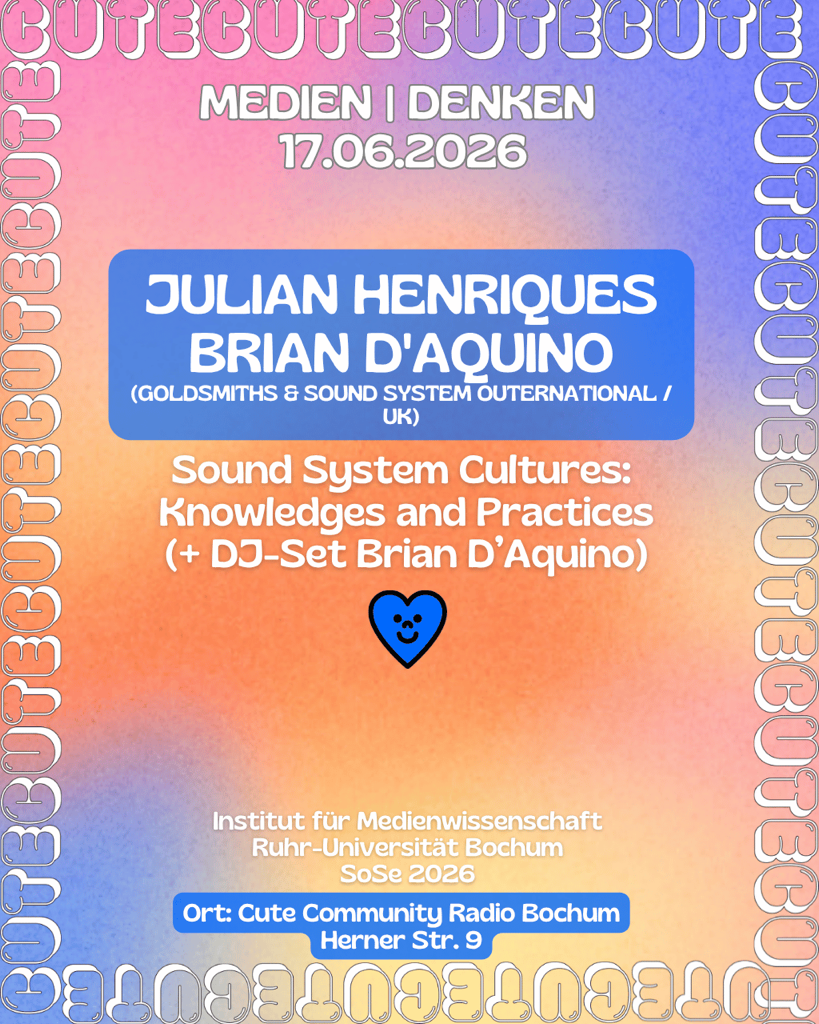
17.06.2026, 18 Uhr, Cute Community Space (Herner Str. 9)
Julian Henriques and Brian D’Aquino from Goldsmiths University, London speak about Sound System Culture: Knowledges and Practices. The lecture is followed by a DJ set.
The event takes place at Cute Community Space Bochum (Herner Str. 9)
Sound System Culture: Knowledges and Practices
In the first part of the talk, illustrated with music tracks, Henriques gives some background on sound system culture in Jamaica based on many years of research there. He concentrates on the classic roots reggae and dub culture as this is what has had the most influence and travelled worldwide. It describes the dancehall session and the sound system as the instrument that gives the music its distinctive sound. As well as the DJs and selectors, the audio engineers play a vital role in fine-tuning their set of equipment to maximise the vibes for the crowd. Their sonic knowledge, techniques and experience is at the heart of the entire dancehall scene.
In the second part, D’Aquino focuses on the electromagnetic diaspora of the reggae sound system, tracing its spread from Jamaica to the UK and Europe and then to the rest of the world. Drawing on five years of global sound system research, alongside his own professional practice, he examines the fractures, tensions, and continuities that shape contemporary reggae sound system culture. The talk explores questions of ownership, adaptation, and the social and political implications of this technomusical practice as it travels across and is shaped by different cultural contexts.
Julian Henriques is convenor of the MA Cultural Studies programme, director of the Topology Research Unit, and co-founder of the Sound System Outernational research group at Goldsmiths, University of London. Previously, he was Head of Film and Television at CARIMAC in Jamaica. His research focuses on street cultures, music, technology, and reggae sound systems. Henriques is also a filmmaker, producer, sound artist, and author, known for works including the reggae musical Babymother, the books Changing the Subject and Sonic Bodies, and the forthcoming Amplifying Power (Duke University Press).
In short: Julian Henriques has been researching, publishing and making films with and about sound systems in Jamaica and the UK for many years. He is a Professor at Goldsmiths, University of London.
Brian D’Aquino is a researcher, sound system practitioner, and music producer based between London and Naples. He is the author of Black Noise (Meltemi, 2021) and he holds a PhD in International Studies from the University of Naples L’Orientale. He is a founding member of the Sound System Outernational at Goldsmiths, University of London, with research spanning the UK, Jamaica, and Colombia. Since 2004, he has run the Bababoom Hi Fi sound system, performing across Europe and beyond and releasing vinyl records on the Bababoom Hi Fi imprint.
In short: Brian D’Aquino is a researcher, sound system practitioner, and music producer based between London and Southern Europe.
Cute Community Radio (CCR) is a Bochum-based hybrid radio space and a vital hub for diasporic art, culture, and knowledge. Emerging from experimental interventions in the public spaces of the Ruhr area, CCR has evolved into a local sanctuary for thinkers and a global platform for cultural exchange. Through a stage dedicated to BIPoC and FLINTA artists*, CCR brings cultural practices into the light without compromise.
This year, CCR embarks on an ambitious investigation into the multifaceted practices of Counter-Cultures and the transformative power of public space. In a landmark collaboration with Sound System Outernational (SSO) at Goldsmiths, University of London and the Institute for Media Studies (IfM) at Ruhr-Universität Bochum, we are exploring how urban sonic cultures function as both vital social institutions and sophisticated technological laboratories.This project is a profound act of recognition. We celebrate diasporic achievements—from the technical mastery of hand-built speaker stacks to the social choreography of the dancehalls—as indispensable intellectual and artistic pillars of modern society. From the streets of the Ruhr to the global airwaves, we ensure that marginalized voices are no longer confined to the periphery but are an integral part of the heart of the public sphere.